机器学习作业第二周
机器学习
这是第二周逻辑回归的作业,经过上一次的作业,我对ocatve和numpy的语法有了一个感觉,所以转换起来也比较方便了。我这次就像他的原版作业一样,两个执行文件,另外把所有需要自己实现的函数都放在func.py里面了。
这次没有什么需要特别记录的坑点。
ex2.py
from scipy.optimize import minimize
import matplotlib.pyplot as plt
import numpy as np
import scipy.special
from fucs import costFuc, costFunction, gradFuc, load, minimize, plotData, plotDecisionBoundary, predict


if __name__ == "__main__":

    # Machine Learning Online Class - Exercise 2: Logistic Regression
    #
    #  Instructions
    #  ------------
    #
    #  This file contains code that helps you get started on the logistic
    #  regression exercise. You will need to complete the following functions
    #  in this exericse:
    #
    #     sigmoid.m
    #     costFunction.m
    #     predict.m
    #     costFunctionReg.m
    #
    #  For this exercise, you will not need to change any code in this file,
    #  or any other files other than those mentioned above.
    #

    # Initialization

    # 步骤一(替换sans-serif字体)
    plt.rcParams['font.sans-serif'] = ['YaHei Consolas Hybrid']
    # 步骤二(解决坐标轴负数的负号显示问题)
    plt.rcParams['axes.unicode_minus'] = False
    # Load Data
    #  The first two columns contains the exam scores and the third column
    #  contains the label.

    data = load('machine_learning_exam/week2/ex2data1.txt')

    X = data[:, 0:2]
    # 一定要reshape不然会变成[0,100]的矩阵
    y = data[:, 2].reshape(-1, 1)
    # ==================== Part 1: Plotting ====================
    #  We start the exercise by first plotting the data to understand the
    #  the problem we are working with.

    print('Plotting data with + indicating (y = 1)\
     examples and o indicating (y = 0) examples.\n')

    plotData(X, y)
    # Labels and Legend
    plt.xlabel('测试 1 分数')
    plt.ylabel('测试 2 分数')
    plt.legend(['接受', '不接受'], loc='upper right')
    plt.title('原始数据集')

    # ============ Part 2: Compute Cost and Gradient ============
    #  In this part of the exercise, you will implement the cost and gradient
    #  for logistic regression. You neeed to complete the code in
    #  costFunction.m

    #  Setup the data matrix appropriately, and add ones for the intercept term
    [m, n] = X.shape

    # Add intercept term to x and X_test
    X = np.hstack([np.ones((m, 1), dtype=float), X])

    # Initialize fitting parameters
    initial_theta = np.zeros((n + 1, 1), dtype=float)

    # Compute and display initial cost and gradient
    [cost, grad] = costFunction(initial_theta, X, y)

    print('Cost at initial theta (zeros): {}'.format(cost))

    print('Expected cost (approx): 0.693')

    print('Gradient at initial theta (zeros):')

    print(grad)

    print('Expected gradients (approx):\n -0.1000\n -12.0092\n -11.2628')
    # Compute and display cost and gradient with non-zero theta
    test_theta = np.array([-24, 0.2, 0.2]).reshape(-1, 1)

    [cost, grad] = costFunction(test_theta, X, y)

    print('\nCost at test theta: {}\n'.format(cost))

    print('Expected cost (approx): 0.218\n')

    print('Gradient at test theta: \n')

    print(grad)

    print('Expected gradients (approx):\n 0.043\n 2.566\n 2.647')

    # ============= Part 3: Optimizing using fminunc  =============
    #  In this exercise, you will use a built-in function (fminunc) to find the
    #  optimal parameters theta.
    #  Set options for fminunc

    # options = optimset('GradObj', 'on', 'MaxIter', 400)

    #  Run fminunc to obtain the optimal theta
    #  This function will return theta and the cost
    # [theta, cost] = fminunc(@(t)(costFunction(t, X, y)), initial_theta, options)

    # 牛顿共轭法 x0必须是(n,)的向量 jac函数返回值要与x0相同维度

    initial_theta = initial_theta.reshape(-1,)  # [n,1]=>[n,]
    Result = minimize(fun=costFuc, x0=initial_theta,
                      args=(X, y), method='TNC', jac=gradFuc)
    theta = Result.x.reshape(-1, 1)
    cost = Result.fun
    # Print theta to screen
    print('Cost at theta found by fminunc: {}\n'.format(cost))

    print('Expected cost (approx): 0.203\n')

    print('theta: \n')

    print(theta)

    print('Expected theta (approx):')

    print(' -25.161\n 0.206\n 0.201')

    # Plot Boundary
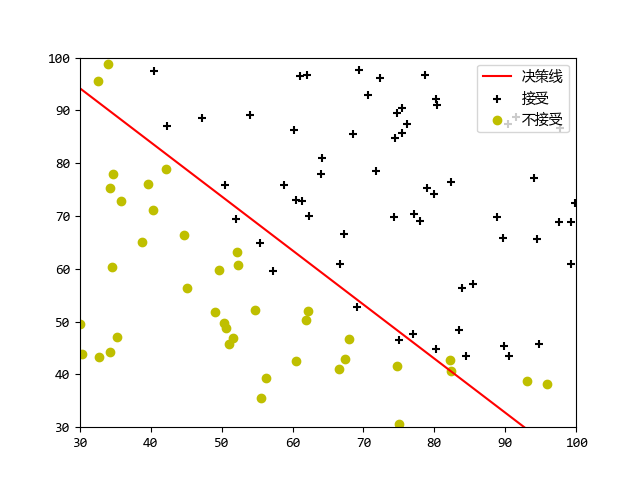
    plotDecisionBoundary(theta, X, y)

    # ============== Part 4: Predict and Accuracies ==============
    #  After learning the parameters, you'll like to use it to predict the outcomes
    #  on unseen data. In this part, you will use the logistic regression model
    #  to predict the probability that a student with score 45 on exam 1 and
    #  score 85 on exam 2 will be admitted.
    #
    #  Furthermore, you will compute the training and test set accuracies of
    #  our model.
    #
    #  Your task is to complete the code in predict.m

    #  Predict probability for a student with score 45 on exam 1
    #  and score 85 on exam 2

    prob = scipy.special.expit(np.array([1, 45, 85])@theta)

    print('For a student with scores 45 and 85, we predict an admission probability of {}'.format(prob))

    print('Expected value: 0.775 +/- 0.002')

    # Compute accuracy on our training set
    p = predict(theta, X)

    print('Train Accuracy: ', np.mean(np.array(p == y)) * 100, '%', sep='')

    print('Expected accuracy (approx): 89.0')

    plt.show()
执行效果
➜  Machine_learning /usr/bin/python3 /media/zqh/程序与工程/Python_study/Machine_learning/machine_learning_exam/week2/ex2.py
Plotting data with + indicating (y = 1)     examples and o indicating (y = 0) examples.

Cost at initial theta (zeros): 0.6931471805599453
Expected cost (approx): 0.693
Gradient at initial theta (zeros):
[[ -0.1       ]
 [-12.00921659]
 [-11.26284221]]
Expected gradients (approx):
 -0.1000
 -12.0092
 -11.2628

Cost at test theta: 0.21833019382659774

Expected cost (approx): 0.218

Gradient at test theta:

[[0.04290299]
 [2.56623412]
 [2.64679737]]
Expected gradients (approx):
 0.043
 2.566
 2.647
Cost at theta found by fminunc: 0.20349770158947478

Expected cost (approx): 0.203

theta:

[[-25.16131857]
 [  0.20623159]
 [  0.20147149]]
Expected theta (approx):
 -25.161
 0.206
 0.201
For a student with scores 45 and 85, we predict an admission probability of [0.77629062]
Expected value: 0.775 +/- 0.002
Train Accuracy: 89.0%
Expected accuracy (approx): 89.0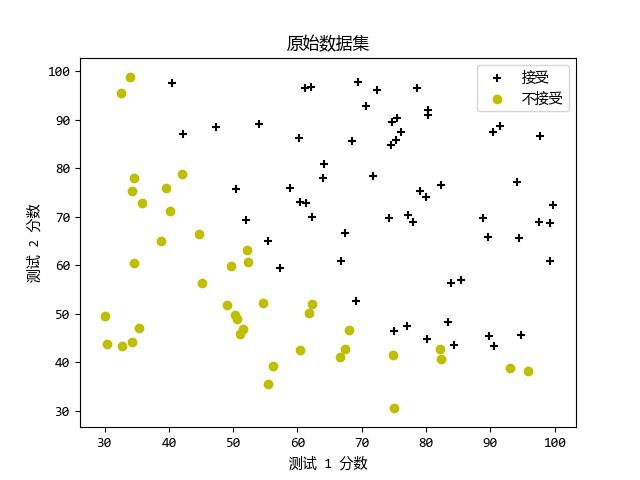
ex2_reg.py
正则化逻辑回归
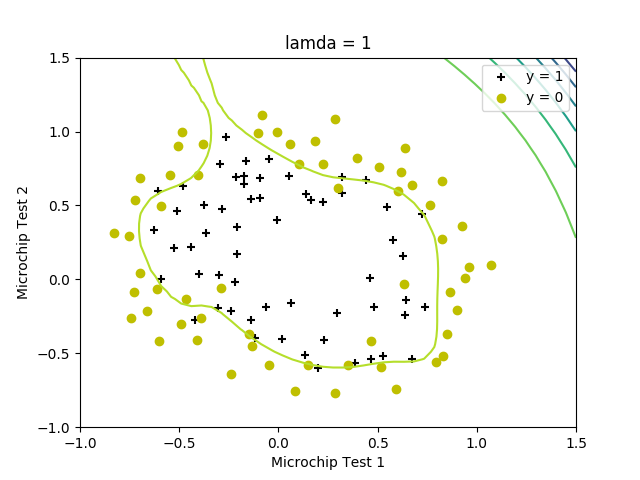
这个程序不但使用了正则化,并且还将数据特征的维度进行了扩展,最终出现曲线
from numpy.core import *
import matplotlib.pyplot as plt
from fucs import costFuc, costFunction, gradFuc, load, minimize, plotData, plotDecisionBoundary, predict, mapFeature, costFunctionReg


if __name__ == "__main__":

    # Machine Learning Online Class - Exercise 2: Logistic Regression
    #
    #  Instructions
    #  ------------
    #
    #  This file contains code that helps you get started on the second part
    #  of the exercise which covers regularization with logistic regression.
    #
    #  You will need to complete the following functions in this exericse:
    #
    #     sigmoid.m
    #     costFunction.m
    #     predict.m
    #     costFunctionReg.m
    #
    #  For this exercise, you will not need to change any code in this file,
    #  or any other files other than those mentioned above.
    #

    # Load Data
    #  The first two columns contains the X values and the third column
    #  contains the label (y).

    data = load('machine_learning_exam/week2/ex2data2.txt')
    X = data[:, :2]
    y = data[:, 2].reshape(-1, 1)

    plotData(X, y)

    # Labels and Legend
    plt.xlabel('Microchip Test 1')
    plt.ylabel('Microchip Test 2')

    # Specified in plot order
    plt.legend(['y = 1', 'y = 0'], loc='upper right')

    # =========== Part 1: Regularized Logistic Regression ============
    #  In this part, you are given a dataset with data points that are not
    #  linearly separable. However, you would still like to use logistic
    #  regression to classify the data points.
    #
    #  To do so, you introduce more features to use -- in particular, you add
    #  polynomial features to our data matrix (similar to polynomial
    #  regression).
    #

    # Add Polynomial Features

    # Note that mapFeature also adds a column of ones for us, so the intercept
    # term is handled
    X = mapFeature(X[:, 0], X[:, 1])
    print(X.shape)
    # Initialize fitting parameters
    initial_theta = zeros((size(X, 1), 1))
    # Set regularization parameter lamda to 1
    lamda = 1

    # Compute and display initial cost and gradient for regularized logistic
    # regression
    [cost, grad] = costFunctionReg(initial_theta, X, y, lamda)

    print('Cost at initial theta (zeros): {}'.format(cost))
    print('Expected cost (approx): 0.693')
    print('Gradient at initial theta (zeros) - first five values only:')
    print(grad[0: 5, 0])
    print('Expected gradients (approx) - first five values only:')
    print(' 0.0085\n 0.0188\n 0.0001\n 0.0503\n 0.0115')

    # Compute and display cost and gradient
    # with all-ones theta and lamda = 10
    test_theta = ones((size(X, 1), 1))
    [cost, grad] = costFunctionReg(test_theta, X, y, 10)

    print('Cost at test theta (with lamda = 10): {}'.format(cost))
    print('Expected cost (approx): 3.16')
    print('Gradient at test theta - first five values only:')
    print(grad[0: 5, 0])
    print('Expected gradients (approx) - first five values only:')
    print(' 0.3460\n 0.1614\n 0.1948\n 0.2269\n 0.0922')

    # ============= Part 2: Regularization and Accuracies =============
    #  Optional Exercise:
    #  In this part, you will get to try different values of lamda and
    #  see how regularization affects the decision coundart
    #
    #  Try the following values of lamda (0, 1, 10, 100).
    #
    #  How does the decision boundary change when you vary lamda? How does
    #  the training set accuracy vary?
    #

    # Initialize fitting parameters
    initial_theta = zeros((X.shape[1], 1))

    # Set regularization parameter lamda to 1 (you should vary this)
    lamda = 1

    # Set Options
    Result = minimize(fun=costFuc, x0=initial_theta,
                      args=(X, y), method='TNC', jac=gradFuc)
    theta = Result.x.reshape(-1, 1)
    cost = Result.fun

    # Plot Boundary
    plotDecisionBoundary(theta, X, y)

    plt.title('lamda = {}'.format(lamda))

    # Labels and Legend
    plt.xlabel('Microchip Test 1')
    plt.ylabel('Microchip Test 2')
    plt.legend(['y = 1', 'y = 0', 'Decision boundary'])

    # Compute accuracy on our training set
    p = predict(theta, X)

    print('Train Accuracy: {}%'.format(mean(array(p == y)) * 100))
    print('Expected accuracy (with lamda = 1): 83.1 (approx)')
    plt.show()
执行结果
➜  Machine_learning /usr/bin/python3 /media/zqh/程序与工程/Python_study/Machine_learning/machine_learning_exam/week2/ex2_reg.py
(118, 28)
Cost at initial theta (zeros): 0.6931471805599454
Expected cost (approx): 0.693
Gradient at initial theta (zeros) - first five values only:
[8.47457627e-03 1.87880932e-02 7.77711864e-05 5.03446395e-02
 1.15013308e-02]
Expected gradients (approx) - first five values only:
 0.0085
 0.0188
 0.0001
 0.0503
 0.0115
Cost at test theta (with lamda = 10): 3.2068822129709416
Expected cost (approx): 3.16
Gradient at test theta - first five values only:
[0.34604507 0.16135192 0.19479576 0.22686278 0.09218568]
Expected gradients (approx) - first five values only:
 0.3460
 0.1614
 0.1948
 0.2269
 0.0922
Train Accuracy: 87.28813559322035%
Expected accuracy (with lamda = 1): 83.1 (approx)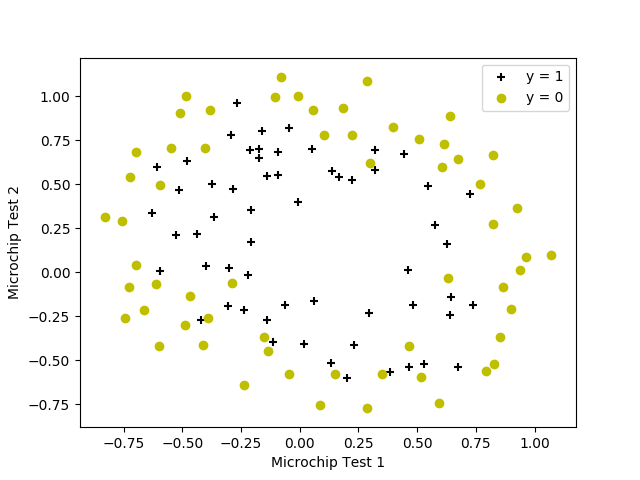
func.py
包含了所有要实现的函数
from scipy.optimize import minimize
import matplotlib.pyplot as plt
import numpy as np
from scipy.special import expit


# 加载数据
def load(filepath: str)->np.ndarray:
    dataset = []
    f = open(filepath)
    for line in f:
        dataset.append(line.strip().split(','))
    return np.asfarray(dataset)


# plot the postive and negative data
def plotData(X: np.ndarray, y: np.ndarray):
    pos = [it for it in range(y.shape[0]) if y[it, 0] == 1]
    neg = [it for it in range(y.shape[0]) if y[it, 0] == 0]
    plt.figure()
    plt.scatter(X[pos, 0], X[pos, 1], c='k', marker='+')
    plt.scatter(X[neg, 0], X[neg, 1], c='y', marker='o')


# plot the boundary line
def plotDecisionBoundary(theta: np.ndarray, X: np.ndarray, y: np.ndarray):
    plotData(X[:, 1:], y)
    # 特征值小于3,那么theta只有2个参数,只需要画直线
    if X.shape[1] <= 3:
        # Only need 2 points to define a line, so choose two endpoints
        plot_x = np.array([min(X[:, 1])-2,  max(X[:, 2])+2])

        # Calculate the decision boundary line
        plot_y = np.zeros(plot_x.shape)
        plot_y = (-1/theta[2, 0])*(theta[1, 0]*plot_x + theta[0, 0])
        # Plot, and adjust axes for better viewing
        line = plt.plot(np.linspace(plot_x[0], plot_x[1]),
                        np.linspace(plot_y[0], plot_y[1]), color='r')

        # Legend, specific for the exercise
        plt.legend(['决策线', '接受', '不接受'], loc='upper right')
        plt.axis([30, 100, 30, 100])
    else:
        # Here is the grid range
        u = np.linspace(-1, 1.5, 50)
        v = np.linspace(-1, 1.5, 50)
        z = np.zeros((len(u), len(v)))
        # Evaluate z = theta*x over the grid
        for i in range(len(u)):
            for j in range(len(v)):
                z[i, j] = mapFeature(np.mat(u[i]), np.mat(v[j]))@theta
        # important to transpose z before calling contour
        z = z.T
        plt.contour(u, v, z)


# 适配原题目中的函数
def costFunction(theta: np.ndarray, X: np.ndarray, y: np.ndarray):
    m = y.shape[0]
    J = 0
    grad = np.zeros(theta.shape)
    # x:[m,n]*theta:[n,1] => z:[m,1]
    h = expit(X@theta)  # h:[m,1]
    J = np.sum(-y*np.log(h)-(1-y)*np.log(1-h)) / m
    # J 的导数
    grad = X.T@(h-y)/m
    return J, grad


# 只计算损失,用于适配scipy的函数
def costFuc(theta: np.ndarray, X: np.ndarray, y: np.ndarray):
    m = y.shape[0]
    theta = theta.reshape(-1, 1)
    h = expit(X@theta)  # h:[m,1]
    J = np.sum(-y*np.log(h)-(1-y)*np.log(1-h)) / m
    return J


# 只计算梯度,用于适配scipy的函数
def gradFuc(theta: np.ndarray, X: np.ndarray, y: np.ndarray):
    m = y.shape[0]
    theta = theta.reshape(-1, 1)
    grad = np.zeros(theta.shape)
    h = expit(X@theta)  # h:[m,1]
    grad = X.T@(h-y)/m
    return grad.flatten()


# 检测结果
def predict(theta: np.array, X: np.array):
    m = X.shape[0]
    p = np.zeros((m, 1))
    p = np.around(expit(X@theta))
    return p


# 扩展特征维度
def mapFeature(X1: np.ndarray, X2: np.ndarray)->np.ndarray:
    degree = 6
    out = np.ones(
        (X1.shape[0], sum([i for i in range(1, degree+2)])), dtype=float)
    # out=[X1, X2, X1.^2, X2.^2, X1*X2, X1*X2.^2, etc..]
    cnt = 0
    for i in range(degree+1):
        for j in range(i+1):
            out[:, cnt] = np.power(X1, (i-j))*np.power(X2, j)
            cnt += 1
    return out


# 正规化的损失函数计算
def costFunctionReg(theta: np.ndarray, X: np.ndarray, y: np.ndarray, lamda: np.ndarray):
    m = y.shape[0]
    J = 0
    grad = np.zeros(theta.shape)  # type:np.ndarray

    # x:[m,n]*theta:[n,1] => z:[m,1]
    h = expit(X@theta)  # h:[m,1]
    J = np.sum(-y*np.log(h)-(1-y)*np.log(1-h)) / m \
        + lamda * np.sum(np.power(theta, 2)) / (2*m)

    # J 的导数 theta [0,0] 需要忽略
    temptheta = np.zeros(theta.shape)
    temptheta[1:, :] = theta[1:, :]
    # print(theta)
    # print(temptheta)
    grad = (X.T@(h-y)+lamda * temptheta) / m
    return J, grad